
24 February 2026
Operations
Systems
Franchising is built on one powerful principle: replication with control. A customer should receive the same quality, service, and brand experience whether they visit a branch in Johannesburg, Durban, or Cape Town. This consistency is what builds trust, strengthens brand equity, and allows a business to scale sustainably.
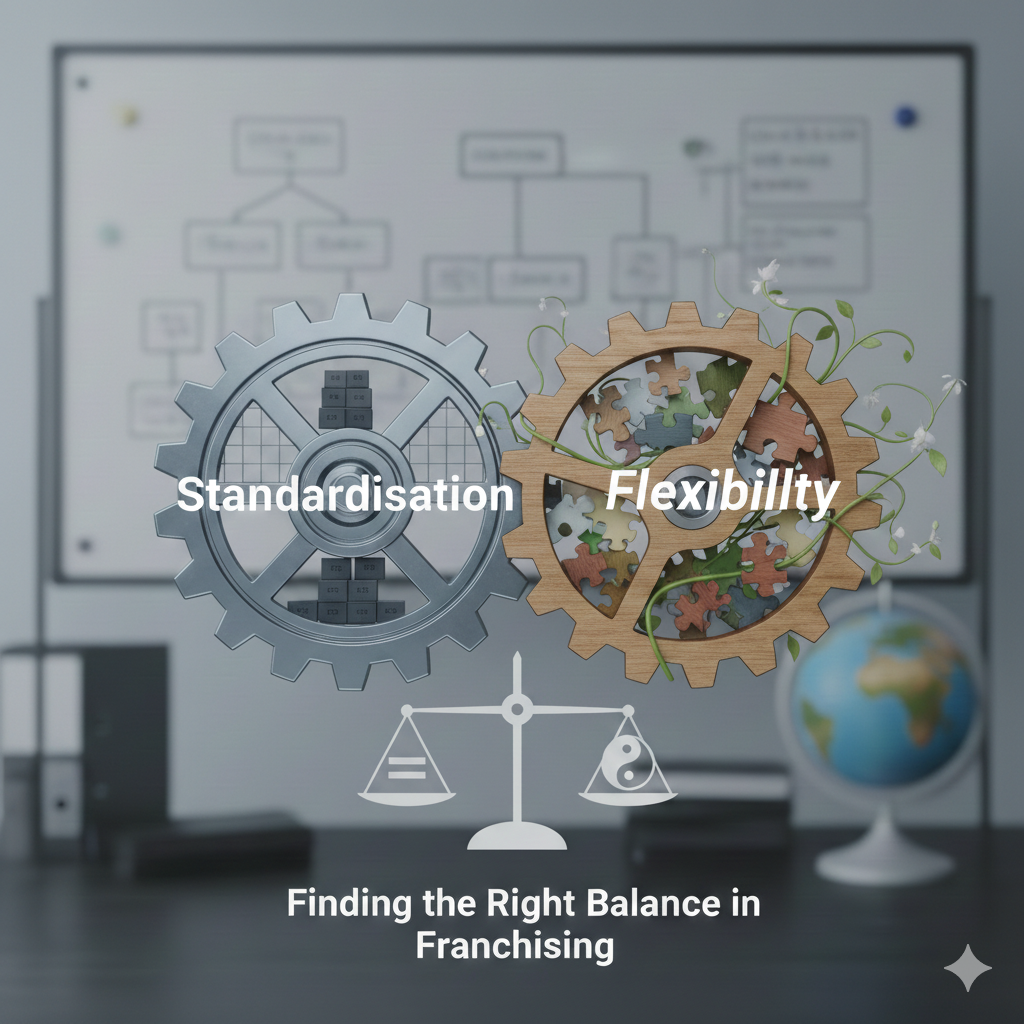
However, as franchise systems expand into different regions and market segments, another reality becomes clear: markets are not identical. Consumer behaviour shifts, purchasing power varies, local competition differs, and cultural preferences influence demand. This creates one of the most important strategic challenges in franchising:
How do franchisors maintain standardisation without restricting franchisees from responding to local market realities?
The answer lies in balance. In our experience advising franchise brands across diverse markets this balance is often the defining factor between sustainable growth and system breakdown.
Standardisation is the backbone of every successful franchise system. Without it, franchising becomes a loose group of independent operators using the same brand name. Consistency ensures:
Customers do not judge a franchise brand by its best-performing outlet. They judge it by their worst experience. A single poorly managed branch can damage the reputation of the entire network.
For this reason, franchisors must be clear about what is non-negotiable.
Brand identity and customer experience must remain consistent. This includes store design, signage, uniforms, service standards, and customer engagement protocols. A franchise brand must look and feel the same across all locations.
Core products and service delivery must also be protected. Product specifications, preparation methods, service scripts, packaging, and quality control procedures ensure that customers receive the same offering regardless of location.
Operating procedures and SOPs are equally essential. Opening and closing routines, inventory management, cash handling, complaint resolution, equipment usage, and supplier processes must follow defined standards.
Training systems must be uniform. A franchise should be structured so that a new franchisee can operate the business effectively, even without prior experience in the industry. Standardised training ensures this.
Finally, financial reporting and compliance systems must remain consistent across the network. Standardised reporting, KPI tracking, royalty payment processes, and compliance requirements ensure transparency and enable franchisors to monitor performance effectively.
These elements form the core of the franchise system. If they are compromised, the franchise model loses its ability to scale.
While standardisation protects the brand, flexibility protects performance.
Franchisees operate on the ground. They understand their communities, customers, and competitive landscape in ways that head office cannot always anticipate. A franchise model that ignores local realities can unintentionally limit performance and create frustration within the network.
Flexibility is often necessary in areas such as:
In markets such as South Africa, where consumer behaviour and economic conditions vary significantly, a one-size-fits-all approach can be impractical. What works in an urban business district may not work in a township market or a rural trading area.
However, flexibility must be structured. If franchisees are allowed to operate without boundaries, consistency is lost and brand integrity declines.
Over-standardised franchise systems often become rigid and restrictive. This may lead to:
Franchisees are entrepreneurs. When they feel like employees rather than business owners, they lose their sense of ownership and drive. This can ultimately impact performance.
Too much flexibility creates inconsistency, and inconsistency destroys trust. Uncontrolled freedom can result in:
If every franchisee modifies the model independently, the business stops functioning as a franchise network and becomes fragmented.
The strongest franchise systems apply a simple principle:
Standardise what protects the brand, and allow flexibility where it enhances performance.
A practical framework is to define three categories:
These protect brand identity and system integrity, such as product quality, customer service, compliance, branding, and approved suppliers.
Franchisees may adapt within defined parameters, such as:
Franchise systems should encourage franchisee insight through structured channels such as advisory councils, performance forums, and pilot programs. This allows innovation without compromising consistency.
The tension between standardisation and flexibility is not a challenge to eliminate; it is a balance to manage. Franchisors who over-control restrict growth and demotivate franchisees. Those who allow too much freedom weaken their brand and create inconsistency.
Sustainable franchising depends on strong systems, consistent standards, and structured adaptability. The goal is not control for control’s sake, but the deliberate design of a system that protects brand integrity while empowering entrepreneurial performance.
The most successful franchise networks are not rigid, nor are they loose. They are intentionally structured clear in their non-negotiable and deliberate in where they allow adaptability.
Getting this balance right is not accidental. It is strategic.

Is your business ready to expand but unsure of the next steps? At Franchising Plus, we specialise in guiding businesses through strategic growth, offering tailored franchising solutions and expert advice. With over 40 years of combined experience, we understand the unique challenges you face and are here to help you navigate them successfully.